

By Heather B. Moore, Author of Julia
My mother is a gardener. She grows vegetables on a vine, or below the soil, and her yard is littered with fruit trees. My childhood memories include picking vegetables right before dinner. Sometimes that meant there was a little dirt in our spinach and beets. I wasn’t too fond of spinach or beets or Brussel sprouts or acorn squash. Thankfully, my adult palate has greatly matured, and I’ll eat almost any vegetable (sans beets). During the 1970s and 1980s when many households were eating canned vegetables and fruits, I was eating them fresh. I didn’t realize that this was a bit of an anomaly until I researched the life of Julia Child in preparation to write a historical novel.
Going into this project, I knew who Julia Child was, but I didn’t really know her beyond her cooking shows. Deep diving into several biographies written about her life, I became caught up in the small details that surprised to me. When the US entered WW2, Julia took action. Joining first the Red Cross, she volunteered for the WAVES and the WAC. She was turned down by both for being too tall. At 6’2” Julia hated that her height was stopping her from serving her country. So she left her sunny Pasadena home and traveled to Washington DC, pounding the pavement for any job to help with the war effort.
She landed with the OSS (Office of Strategic Services), working under General Bill Donavan, a decorated WW1 veteran. Soon, Julia applied to serve overseas and was assigned to India. When she and eight other women arrived in Bombay, they were divided up, and Julia was assigned to Ceylon (now Sri Lanka). There, she met a man who was short, balding, and old. Paul Child at 5’9” was indeed shorter, and he was ten years older, and yes, he was balding.
But over the next months, Julia fell in love with her dear “Paul-ski” who taught her to appreciate art, literature, languages, and food. This was all new to the golf-and-tennis gal who was more likely to play pranks than read a book.
Julia was in her mid-thirties when she married Paul, and she immediately aspired to be a housewife who cooked dinner for her husband. After many kitchen disasters, they spent more time eating at restaurants than cooking at home. When the couple moved to Paris, Julia tried authentic French food for the first time. She immediately became enamored. She loved the sauces, the fish, the fresh vegetables, and the bread . . . Oh, the bread. She immersed herself in French cooking. Shopping daily at the outdoor market, trying recipes over and over, and buying every kitchen gadget she could find. She learned the French language with gusto and enrolled in the famous cooking school Le Cordon Bleu.
Upon graduation, Julia asked herself what to do next? When two of her French friends invited her to be the American voice in their cookbook, Julia dove in with her entire heart. It would take nearly ten years and two cancelled publishing contracts to see the coauthored cookbook, Mastering the Art of French Cooking, on the shelves. In the meantime, Julia moved from Paris to Marseilles, then to Germany, followed by Norway, and finally back to the US.
When Julia was invited onto a public television program to talk about her cookbook, she brought along eggs to demonstrate making an omelet. Letters poured into the news station following the episode, asking for more of Julia and her cooking. Next thing she knew, she was offered a cooking show television series, which would be known as The French Chef.
Now, in her early fifties, Julia began a second stage in life that brought her larger-than-life personality into every American home with a television. Her husband Paul had retired just in time to become Julia’s right-hand assistant, becoming the man-of-all-trade by timing her show rehearsals, photographing images for her next cookbooks, and washing dishes after her presentations.
Julia and Paul’s marriage endured WW2, post-war Europe, health complications, career failures, sorrow over childlessness, volatile world politics, and lost hopes, only to be buoyed by supporting each other’s ever-changing dreams.
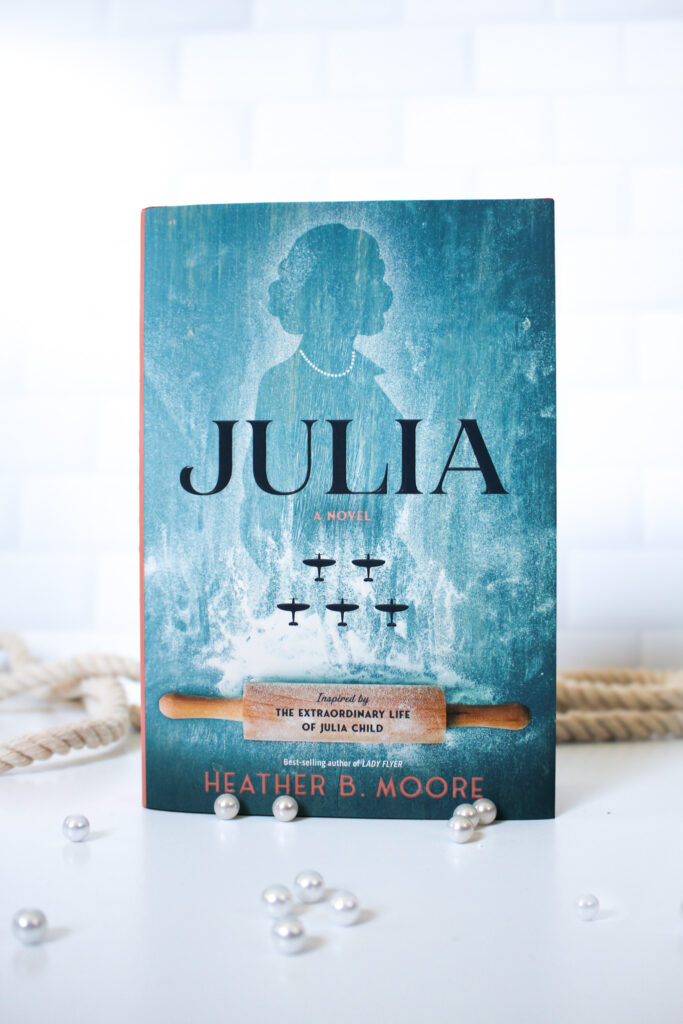
“This is a lovely historical fiction that draws us into Julia’s world. While everyone knows about her cooking, the details of her life in the OSS, trusted with America’s secrets during WWII, are lesser known and very intriguing. The book is well-researched, but it manages to stay warm and inviting, just as she was. Highly recommended.” –Historical Novel Society
Before she stepped into the spotlight as a master of French cooking, Julia Child navigated the shadows as a WWII intelligence officer.

Heather B. Moore is a USA Today best-selling and award-winning author of more than seventy publications. She has lived on both the east and west coasts of the United States, including Hawaii, and attended school abroad including the Cairo American College in Egypt, and the Anglican School of Jerusalem in Israel. She loves to learn about history and is passionate about historical research.
